

CASE STUDIES / ENGINEERING PROJECT
CASE STUDY: ENGINEERING A COLLAPSIBLE ICE CUBE TRAY FOR RELIABLE RELEASE
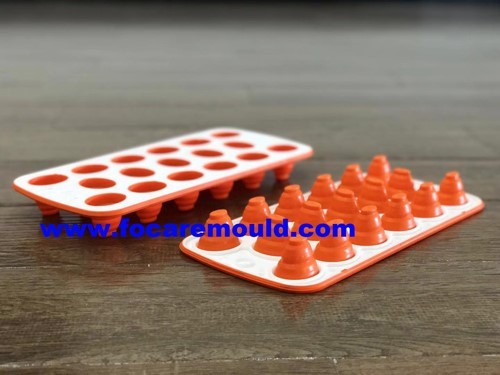
This engineering case study combines Focare Mould’s published 1+1 cavity PP+TPE ice-tray tooling reference with Avient’s public TPE overmolding design guidance. It explains how soft-bottom release, thickness control and two-shot mold architecture should be evaluated without claiming unpublished production results.
PUBLISHED TOOLING REFERENCE
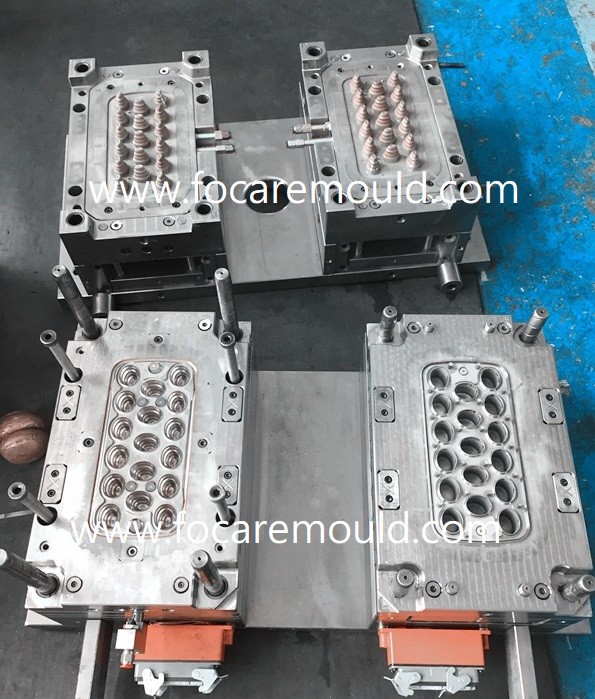
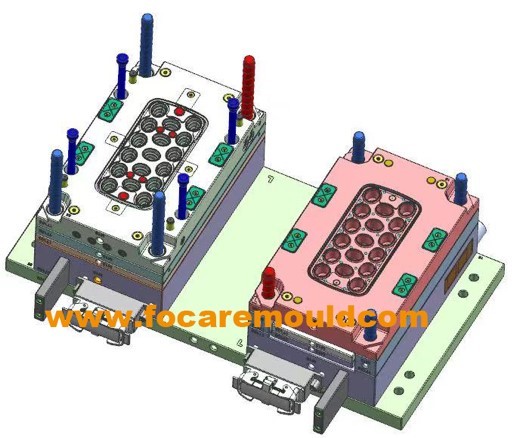
Focare publishes the following configuration for a two color ice cube tray. Machine references differ between public pages, so final compatibility must be checked against the exact tool and machine drawings.
PP rigid frame + TPE flexible bottoms
1+1 cavity
718H, 30–33 HRC
PP: 1-tip HR to cold runner
TPE: 1-tip HR to cold runner
Two-shot rotary injection molding
FCS KN-200R / FB-250R; Yizumi UN260CG-BTP on a separate 2026 exhibit notice
SOFT RELEASE WITHOUT SACRIFICING PART STABILITY
CONTROL TPE THICKNESS
The flexible bottoms must deform enough to push out ice while staying uniform enough to avoid local sink, warpage and inconsistent cooling.
PROTECT THE PP–TPE INTERFACE
Shut-offs, material compatibility and optional mechanical interlocks must prevent flash, peeling and boundary variation during repeated flexing.
RELEASE SOFT FEATURES CLEANLY
Draft, radii, cavity finish, cooling and ejection contact must be developed around the selected TPE hardness and geometry.
ROTARY TWO-SHOT SEQUENCE WITH RELEASE-FOCUSED DFM
The published concept molds the rigid PP frame and flexible TPE sections in a rotary two-shot process with separate hot-runner-to-cold-runner feeds. For a new program, recommended DFM checks include gradual thickness transitions, radiused corners, adequate long-draw draft, end-of-fill venting, cooling close to the TPE cavity and ejection that avoids marking the soft surface. Avient identifies 1.5–3.0 mm as a common overmold wall range and recommends 3–5° draft per side for long draws; these are general starting points, not confirmed dimensions for this tray.
RESULTS & VALIDATION DISCLOSURE
The public product page states that the soft TPE bottom helps users release ice and that controlling TPE thickness is essential. It does not publish cycle time, scrap rate, dimensional capability, bond strength or long-term flex-test results. Those outcomes must therefore be treated as validation targets—not proven production results.
A suitable trial plan should verify cavity filling, PP/TPE boundary flash, part flatness, freezer-condition release, repeated bottom flexing, odor/food-contact requirements and mold–machine compatibility.
Focare product source · Focare 2026 tooling notice · Avient TPE design guide
PP+TPE COLLAPSIBLE ICE TRAY FAQ
Can the published machine references be used without checking?
No. The public pages list more than one machine reference. Final approval requires the exact mold size and weight, shot volumes, nozzle layout, platen and tie-bar dimensions, rotary direction, opening stroke and ejector interface.
How should TPE thickness and draft be selected?
Use the selected TPE grade, hardness, flow length, freezer performance and flex target. Avient’s published ranges are design starting points; the final geometry requires supplier data, flow analysis and physical trials.
DEVELOPING A FLEXIBLE PP+TPE HOUSEHOLD PRODUCT?
Share the 3D part, PP and TPE grades, hardness, food-contact requirements, flex-life target, cavity target and machine data for a project-specific DFM and trial plan.