
PRODUCTS / TWO COLOR PLASTIC CUP MOLD
TWO COLOR PLASTIC CUP MOLD
A published two-color tooling reference for a 350 ml plastic cup, combining a 4+4 cavity layout, 718H steel and a 4-tip YUDO hot runner. The page separates verified project data from engineering recommendations for new programs.

IMAGE NOTE — MOLD TRIAL SETUP
The published trial image documents the mold installed in a two-color molding cell. For a new project, platen size, tie-bar spacing, nozzle layout, rotary interface and shot capacity still require machine-specific confirmation.
PUBLISHED CUP MOLD SPECIFICATIONS
The following dimensions and tooling values are published by Focare Mould. Resin grades, cycle time, dimensional tolerance and production-machine model are not stated and must be confirmed during DFM.
Two-color plastic; resin grades not published
4+4 cavities
718H, 30–33 HRC
4-tip YUDO hot runner
1090 × 550 × 526 mm / 1688 kg
Ø86 × 104 mm · 27.3 + 20.2 g · 350 ml
ENGINEERED FOR REGISTRATION, SURFACE QUALITY AND CAVITY BALANCE
4+4 CAVITY BALANCE
Runner sizing and gate timing should keep the eight first- and second-shot cavities balanced for consistent cup weight and color-boundary quality.
CIRCULAR REGISTRATION
Rotary positioning, cavity matching and shut-off control must maintain even alignment around the cup rim and patterned outer surface.
VISIBLE-SURFACE CONTROL
Polishing, venting, cooling and ejection require careful development to reduce flow marks, deformation and handling damage on visible drinkware surfaces.
DESIGN THE LONG-DRAW CUP FOR RELIABLE 2K RELEASE
A 104 mm-tall cup requires review of draft, wall uniformity, rim roundness, venting and cooling before steel is released. The second-shot boundary also needs adequate sealing and repeatable rotary transfer. Since the source does not publish resin grades or performance results, material compatibility, dishwasher or food-contact requirements, color adhesion and drop testing should be defined for each new program.
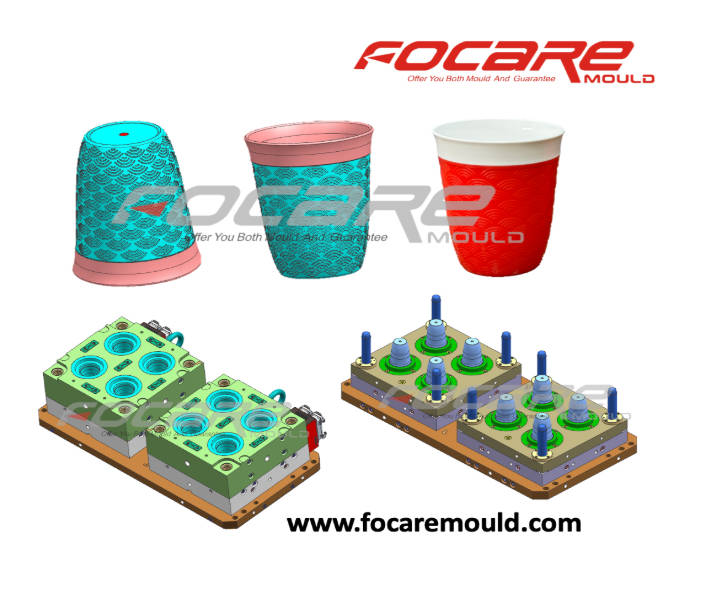
IMAGE NOTE — PART & TOOL STRUCTURE
The reference shows the finished two-color cups together with the paired mold halves. The visual supports a 4+4 cavity concept; final cavity layout, transfer orientation and gate vestige position must follow the approved 3D product drawing.
VERIFY COLOR BOUNDARY, ROUNDNESS AND FUNCTION
The molded-cup photo provides a visual reference for the white inner/rim area and colored patterned outer wall. It does not prove production capability figures. A new-tool validation plan should record fill balance, part weight, rim roundness, concentricity, color-boundary flash, adhesion, drop performance and the customer’s food-contact or washing tests.
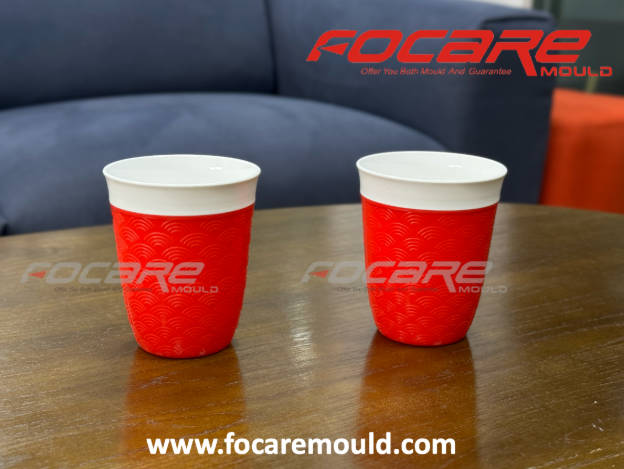
IMAGE NOTE — MOLDED CUP SAMPLE
The finished sample shows the intended two-color appearance and long-draw cup geometry. Acceptance criteria should be agreed before trial because cycle time, tolerances and test results are not published for this reference.
TWO COLOR PLASTIC CUP MOLD FAQ
Which materials can be used for the two colors?
The published project does not identify the resin grades. Material selection should be based on food-contact requirements, interlayer bonding, shrinkage compatibility, heat resistance, appearance and the intended washing or reuse conditions.
What machine data is required before mold design?
Provide the two injection-unit shot capacities, nozzle spacing, platen and tie-bar dimensions, rotary-table diameter and direction, opening stroke, ejector interface and available hot-runner controls. The source does not publish a confirmed machine model.
DEVELOPING A TWO-COLOR CUP OR DRINKWARE PRODUCT?
Send the 3D cup drawing, material candidates, food-contact standard, annual volume, target cavity count, color-boundary requirements and two-color machine specification for a project-specific DFM review.